
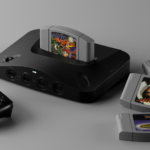
Before I got my Analogue 3D Nintendo 64-compatible console, I scoured the local retro video game stores and conventions looking for all the Nintendo 64 RPGs that I could find. And I got a bunch.
I already had Legend of Zelda: Ocarina of Time and Ogre Battle 64: Person of Lordly Caliber, and I wrote on this blog when I played the latter. At that time, on my original quarter-century old box, running the S-Video signal into a HDMI converter so I could play on a modern monitor. My search for other games got me Paper Mario 64, Perfect Dark (long considered one of the best games available on the N64), Hybrid Heaven (gut reaction: “weird”), the Aidyn Chronicles, Zelda: Majora’s Mask (I rented this back in the day, never owned it), and Quest 64.
I immediately dove in… to Perfect Dark. A couple hours in, I realized that the Analogue 3d was not actually saving my games. There was a special way of shutting down the system I needed to do to copy the saves into permanent storage. Nowhere did it say to do this. I found the answer on Reddit, as I often do.
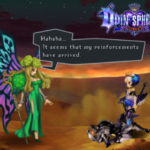
Meanwhile, I’d been following N64 news on BlueSky and Mastodon and for some reason, the only Nintendo 64 RPG anyone talked about was Quest 64. I got immediately that it was ironic; nothing gets past me when sarcasm is involved. I’d played a few minutes of the game when I was checking to ensure all the carts I had worked on the system, got turned around a few times, fought with the camera a few times, and moved it to the back of my play list. But people just kept talking about it. When I had a few hours free to play a N64 game, it was Quest 64 that got put into the machine.
In Quest 64, you play an apprentice mage named Brian. Your father, the king and a powerful magician in his own right, has gone to face a powerful evil. No word of him has come back. The monastery that has been a second home to Brian says that only the son of such a powerful king can find him and return him, and that son is Brian, and so off you go.
Brian is a blank slate, as far as his career goes. He has obtained a spirit gem for each of the four elements (fire, water, earth and air) and a magic spell from each of the schools. There are no classes; Brian can learn whatever spells he wants, if he finds enough spirit gems. Some can be found; most come from battles. Water has the healing, water and ice spells; fire the medium range dps; earth the close range dps; air the long range dps. All the guides say to get the healing spell from water as quickly as possible, and then focus on a certain school of magic. I focused on air and water; toward the end of the game, I’d maxed air and earth and was working on water.
All the enemies are associated with one of the elements, and of course there is a strong against/weak to relationship between the elements — fire vs water, air vs earth. Brian also is a mean melee fighter; his staff packs a punch.
You can say there are no levels in Quest 64, but it’s more accurate to say that everything is a level. Your health, magic, agility, defense and magical power all increase with use. You’ll need to get hit and do melee attacks to raise most of these things; magic is increased by casting spells. Since I initially chose air, I didn’t get hit much. I had to spend a few hours before the endgame getting into fights and letting myself get hit to get my stats up.
The minimal story is appropriate for the minimalistic environments. The four elemental stones of power have been taken by evil people from those who would guard them, and Brian needs to hunt them down and find them. With all four stones gathered, Brian needs to find the Eletale Book, depose an evil king, and face down the ultimate evil force before he can finally save his father.
That is Quest 64. The question remains: is this the worst RPG on the Nintendo 64?
Let’s place it in its context. The PlayStation had released Final Fantasy VII the year before, similarly a 3D RPG. Brave Fencer Musashi was defining action RPGs in the console era; Jade Cocoon and Parasite Eve would come out the next year; Lunar 2: Eternal Blue and Lunar: Silver Star Story were charting new dimensions in 2D RPGs; Shining Force III was refining the tactical RPG formula. These are just some of the console RPGs that competed with Quest 64 (AKA Holy Magic Century AKA Eletale Monsters, its title in Japan). So, no, it in no way compares to the RPGs available for other consoles at the time.
On the Nintendo 64, it faced off against Ogre Battle 64 and Hybrid Heaven. Your opinion of Hybrid Heaven (if you have one) aside, Ogre Battle 64 is one of the best real-time tactical RPGs ever released, with an amazing story that continues through games for the SNES and PS1 to the PS4.
So yeah, it’s clear — Quest 64 is the worst RPG for the N64 (of those that I have played), and does not compare well to the state of the art in other consoles. There’s probably a reason there why it didn’t do that well commercially, or get the sequel it deserved (a N64 follow-up set a century later was planned but cancelled; Quest: Brian’s Journey for the GBC is more or less a port of the N64 game).
But, is it a bad game?
No, by no means. Taken on its own merits, it is a sparse game that trades a deep story for a deep battle system. It’s this battle system where it shines. Each enemy has from one to three different attacks, and they will choose them based on how you react. Battles take place in a large circle drawn on the current terrain. If you leave this circle, the battle ends (though you get no experience credit). You can move around this battle circle in a smaller circle centered on Brian. The monsters are also confined to their separate battle circle, and similarly, they can move within it to get closer to Brian in order to be in range. Brian can try to kite things around the circle, or dodge attacks in real time. If you’re good, Brian will hardly ever take any damage.
This would be best, as before Brian learns the first of the two heal spells, items are the only way to heal in the field; there is no healing of wounds over time, although magic power comes back quickly when not in battle (or when hitting an enemy with the staff). There are no shops in Quest 64, and no gear, and no money, so there’s no popping back into town to stock up. Some NPCs will hand you healing items if you are short, and sometimes there are treasure chests to find.
Quest 64‘s worst failing is that it is unbalanced. There is a certain combo deep in the earth magic school that will allow you to kill almost anything with zero risk to Brian, and this includes the toughest bosses, including the final boss, Mammon. “Magic Shield” prevents all harm and lasts 2-5 turns; “Avalanche” does a lot of AOE damage to everything close in front and next to you. This will eventually kill anything that doesn’t resist earth magic. Naturally, you’ll want to have high health for when the shield drops unexpectedly, and high magic to sustain this expensive combo, so it’s only really useful toward the end of the game. But once you have the needful, what should have been the hardest part of the game becomes the easiest.
I enjoyed my time with Quest 64. It knows what it is and it leans into it. I haven’t played a game like it before and I won’t play a game like it again. I’m glad I spent the hours I spent playing the worst RPG on the Nintendo 64.
Here’s the final battle; you’ll see the broken combo at work.

I didn’t know it was considered the worst RPG. Noted.
There were so few RPGs on the N64 that I don’t feel there’s really enough of them to make that determination. I feel people calling it “the worst” bundles the assumption that it is therefore “bad”.
It certainly comes up short against Ogre Battle 64 and Paper Mario. I haven’t played much of Hybrid Heaven or The Airdyn Chronicles, but that’s pretty much all the RPGs on the system I can think of — and people can argue that Paper Mario and Hybrid Heaven shouldn’t be on the list. So, three RPGs, ranked… there’s just not enough to work with.
Still, it’s considered “the worst” by people who need something to contrast with “the best”. Which is Ogre Battle 64 IMHO.