At some point, I think, there will come a time when 3D printing will be as easy and painless as all the YouTube videos make it out to be. Guy builds a giant LEGO castle, no problem. Someone tests a hundred different filaments, smooth sailing.
Me, it’s one thing after another. It’s crazy, but I am on my fourth 3D printer. My Creality Ender 3 Pro, my first one, still works fine… fine for an Ender Pro that has a tough time keeping the bed level even through a print. I have replaced so many bits on that. The Prusa Mk 3 had spitzen sparken one day. The Anker Make I kickstarted just won’t print anymore and lord knows why.
The Bambu P1S was supposed to be plug and play and worry free… and to be honest, it mostly is that way. I’ve had bed adhesion issues, but I have become an expert at cleaning the build plate and reapplying an even layer of hairspray to it. And letting it dry thoroughly — this was the big lesson. Now I can print a dozen or so things between having to rinse and repeat.
You don’t see this on the YouTubes.
The best part of the Bambu, and the reason I was excited to upgrade to it in the first place, is the AMS (Automatic Material System). This is a 4-to-1 filament feeder that allows you to print from up to 16 colors at once (by chaining them together; not exactly sure how that goes). This cuts drastically down on the filament changing and, if I feel like dealing with a lot of plastic waste, can easily do multicolor prints.
The problem is the filament. Plastic filament lives in the real world, and the real world can be dry or humid, light or dark, and all these things affect the filament. Filament that has been in a warm and humid environment will soak up water from the air and print poorly, eventually becoming brittle and snapping to pieces inside the printer… or worse, in the AMS.
This has happened a couple of times. Each time, I have to open up the AMS and hope I don’t fug things up too much. This last time, shards of red PLA filament were scattered everywhere. I cleaned it all out, put it back together and — the filament wouldn’t feed. Help online suggested the feed motor was busted. It seemed just a little too convenient that the feed motor would die just when the filament snapped, but, well, time to go to the Bambu Labs page and order a new motor and HELLO WHAT IS THIS?
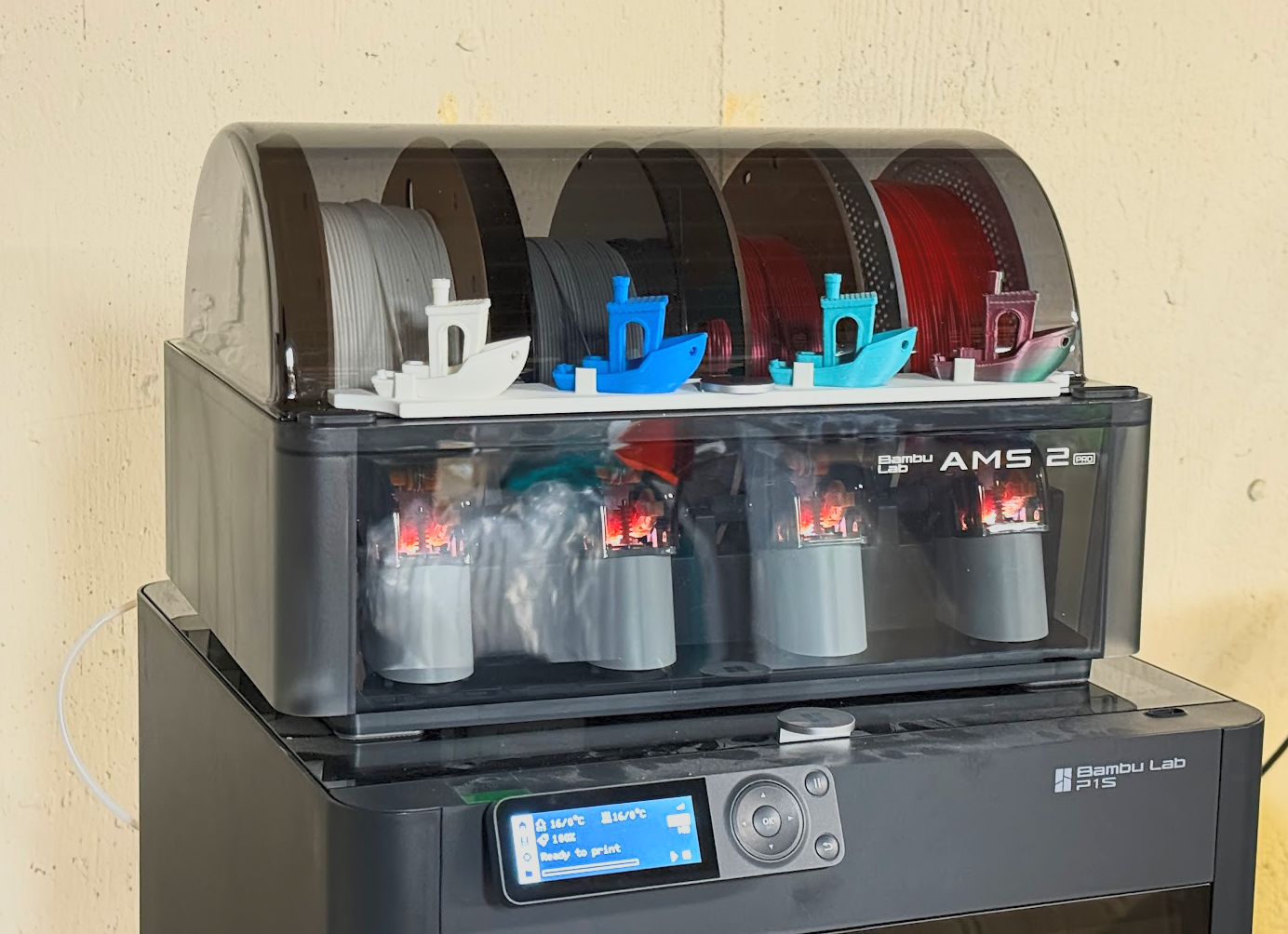
Bambu had just come out with an upgrade to their AMS — the AMS 2 Pro. More accessible filament paths. Better desiccant storage. But, most importantly — a built in filament dryer.
Have some old filament that has been sitting around in the open air for a couple of months? Put it in the AMS, turn on the dryer, wait twelve hours and now your filament is ready to go.
I admit to running every bit of opened filament I had through it, including some very old silk PLA filament (third from the left in the picture; its benchy is the rightmost). That stuff was expensive. After drying all the filaments except one passed the “snap” test — bending the filament until it snaps. If it snaps, it’s trash. If you can’t get that to snap — it’s good.
It’s been trouble free, so far. I’ve been printing a bunch of stuff and where I’ve had issues, it’s been in the printer and not in the AMS, and most of that has been the consistent bed adhesion issues. But for those, learning to clean the plate and apply an even layer of hairspray — and letting it dry — has been the secret sauce.
So, new AMS, yay. I hate how much 3D printer hardware I go through, but… If you gotta print, you gotta print.
Like anything else, the thing that T-bones everyone in 3D printing eventually — before they start or shortly after — is how much gd WORK there is just to maintain not only the machine, but the ecosystem. I had tried to make a rack for my filament, but just put all of the spools back into their cereal box containers to keep them dry…I didn’t know I’d be buying cereal containers in bulk when I got my printer. I just got a 4-slot filament dryer for Christmas, because apparently I need that “just in case” (I have used it twice so far, so I guess I’m winning). Tools, accoutrements, materials, places to put the damn things, lighting…no hobby is inexpensive or easy these days.
Before I got a 3D printer I would send things to Shapeways and they would always come back perfect. It was expensive, but it wasn’t four 3D printers and two AMSs expensive.
Sigh.