Prior to playing STV:AtU, I think the most authentic “Star Trek” experience I had, in a video game, was in Star Trek Online, the Cryptic MMO. The most authentic Star Trek experience I ever had in real life was getting to go to Las Vegas only to find that the actual “Star Trek: The Experience” was just shutting down forever. The crushing disappointment I felt then was matched only by the crushing disappointment I felt after playing pretty much every other Star Trek-based game.
Some come closer than others. I’ve enjoyed a lot of the games, bounced hard off of others (especially the terrible mobile games).
STV:AtU, though, feels like Star Trek. In Star Trek: Voyager: the TV Series, a newly christened Intrepid-class starship, the Voyager, is sent on its maiden voyage to track down some Maquis terrorists who are upset the Federation has allied with the Cardassians against the Dominion. Bad stuff happens, yada yada yada, and both the Maquis and the Voyager end up on the other side of the galaxy, 70,000 light years from home. The two groups are forced to form an alliance (i.e., the Federation says join us or die, which some of the Maquis resent) as they embark on their 20+ year journey home through space that has few friends but many enemies.
The game generally follows the plot of the show, gathering at certain decision points that were decided one way in the show, but allowing for different decisions in the game. For instance, one early decision point allows you to… just go home the way you came. This would have made for a very short TV series, but it’s your game, you can do what you want. How you deal with the insurrection among your blended crews worked one way in the series; you can make different choices here.
Aside from the choice to end the game early, most of these choices affect which important crew members — actually called “heroes” in the game — are available for assignment. More than anything, your heroes will determine how well you do in the various minigames.
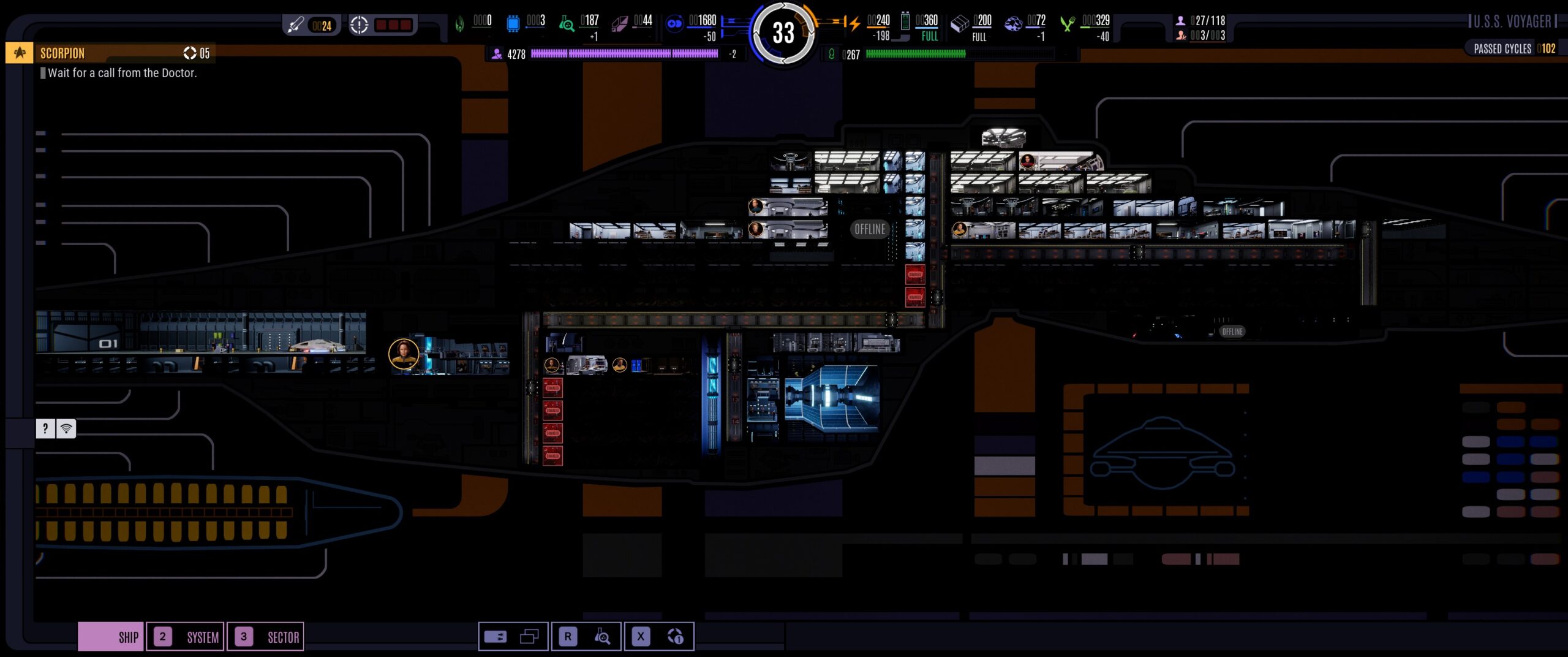
The ship
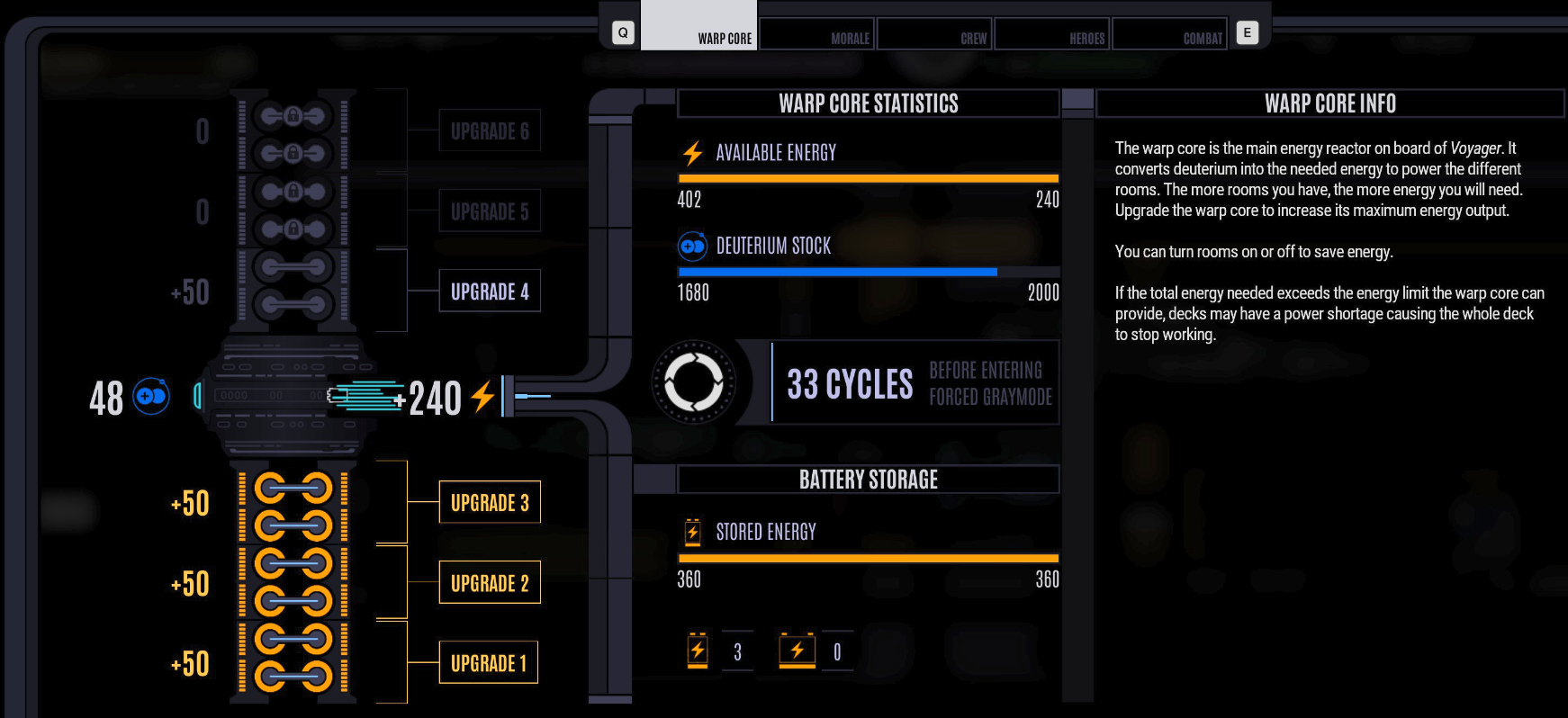
Being hurled across the galaxy didn’t do Voyager many favors; in the game, the ship just barely survives with almost every part of the ship damaged, and the warp core able to give only a fraction of the power needed to function at full capacity. As in X-Com 2 or Fallout Shelter, you’re given a cutaway view of your base and must assign work crews to clear out rooms and assign the newly cleared areas functions. In Voyager, these range from survival-focused areas such as crew quarters and hydroponics areas, but rooms devoted to combat and defense functions, sickbays (crew get sick and injured a lot. Why, just random console explosions alone keep the EMH busy, and I am not even kidding.)
The matter-antimatter engines run on deuterium, and although deuterium is plentiful in most systems, you use quite a lot, especially if you’re still booting up your hydroponics bays and need energy to replicate meals for your crew. Dilithium is used for upgrading your warp core and some other things, and this is somewhat harder to come by. Tritanium is used for most new rooms, along with good quantities of Duranium, that you will use for nearly everything but especially to keep the hull repaired. Straight up food can be obtained via picking up random biomass from planets, from the hydroponics bays, through trading or through exploration. Did you think that Voyager went through a lot of shuttlecraft? Now that’s your problem. Shuttlecraft can do quite a lot, but they die easily, and they usually take a few crew with them. Morale is the last resource. Your people want to go home, and you’ll have to balance exploration that can bring you more resources, heroes or tech vs everyone’s impatience to just get going.
Keeping all of these things balanced is the major activity in STV:AtU.
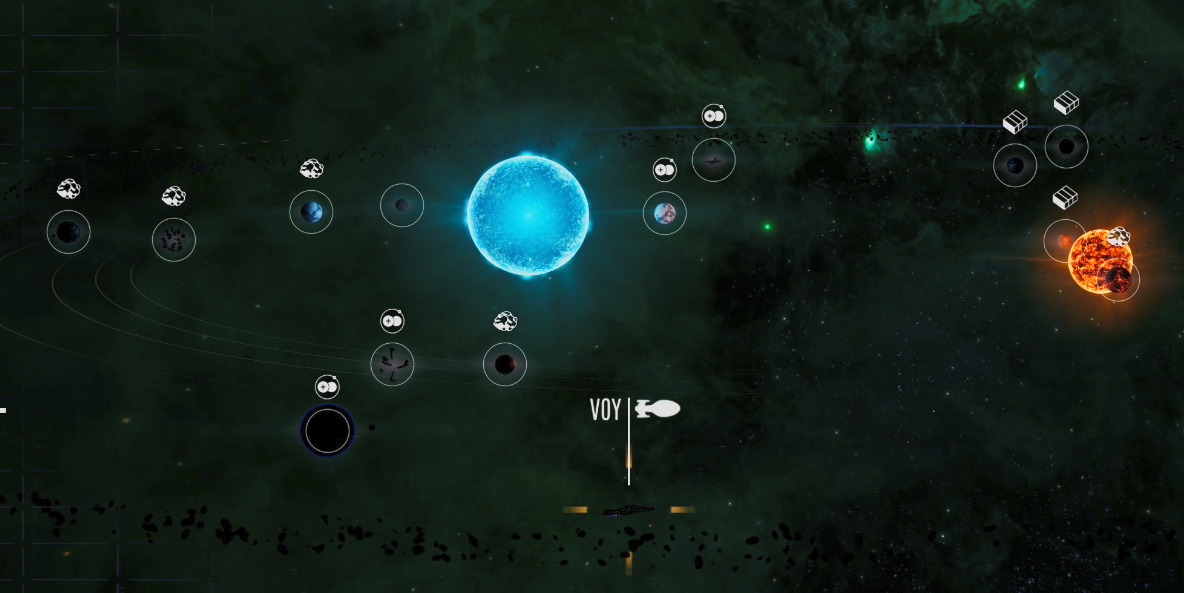
Exploration
The game is split into 12 story arcs — sectors — that lead the crew back to Earth. Wikipedia says that the order of the plot arcs is randomized, but that seems unlikely; the plot has so far tracked the plot of the show fairly closely. As of Sector 6, my playthrough has just entered Borg space and has faced off against Species 8472 and been to Fluidic Space and back. This took a bit longer when I did it in Star Trek Online, but it’s nice to play through the story in two games that did it well.
The exploration loop is: go from system to system within a sector, scanning the planets, moons, asteroids and whatnot to reveal their resources, then plot a course through them such that, after gathering all the resources and building the rooms you need to be building, researching what you need to research and all, you’ll move along to the next system or sector with all your meters pinned to full. Gold delta symbols mark locations that will advance the main story plot; blue delta symbols mark locations that will take you on side quests which are always worth doing.
Each system has a danger level, from 0-3, that determines how likely you are to be attacked as you’re out and about. In ship combat, you choose three heroes, each with their special abilities, who do the actual flying of the ship. Your job, as captain, is to give the order to attack, or the order to defend to save a particular area of shields, or to flee or to surrender. As captain, it’s your finger on the photon torpedo button. You can also choose which particular enemy to attack (if there is more than one) and which system to target. Some story beats are hidden behind disabling rather than destroying an enemy.
Store points of interest generally involve sending an away mission to the planet. You are given a list of four-five decision points, and which abilities (combat, science, medical, tech, diplomacy, leadership) are required to pass each one. There may also be special options for heroes that have certain traits, such as being Vulcan. You’ll want to choose heroes that can hit at least one of the requirements for each decision point, and doubling up on abilities allows you to work together with other heroes. Heroes do get fatigued if their abilities are called upon too often, so you will definitely want to work on synergies here.
Once the away mission begins, there will be some text, and a series of ability tests and outcomes. You’ll assign one or more heroes to it, then a bouncing gauge will determine if you pass or fail the test. If your success chance was over 100%, you might get a critical success that will bring better rewards. If you fail a test, the plot might change slightly, heroes might get injured, and so on.
Heroes
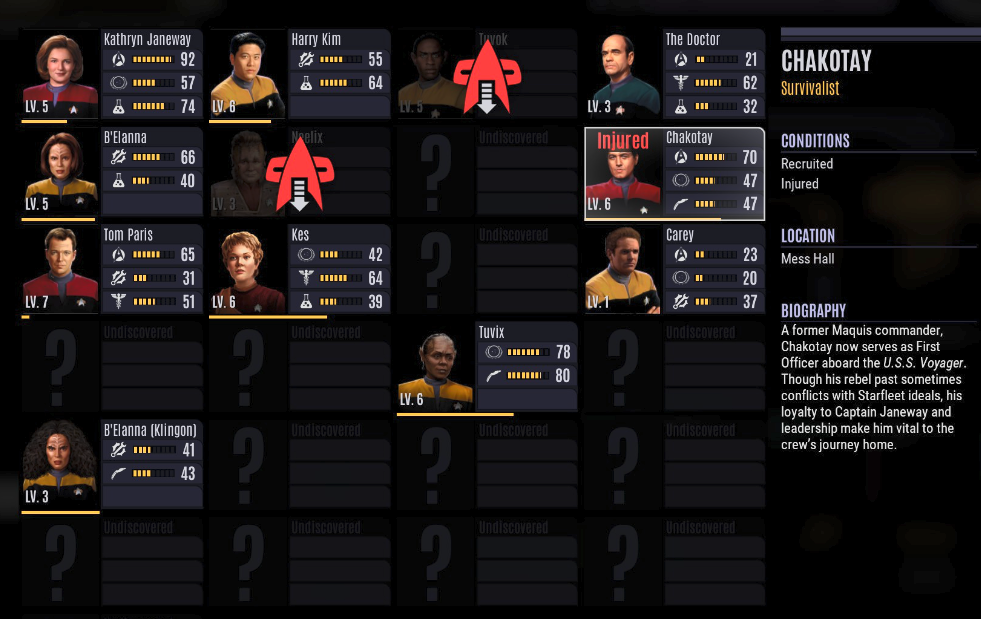
Yes, I kept Tuvix… and regretted it. I lost two superior heroes for an inferior one. And B’Elanna never got reintegrated, so now there’s her hybrid human/Klingon original recipe, and the 100% Klingon extra crispy recipe. Not sure what happened with that; I don’t remember ever getting the option to reintegrate her. I must have left the sector without resolving that storyline.
It seems I missed a couple other heroes along the way from there to here. I think I might just be about to recruit 7 of 9. I wonder if that means Kes is about to die. That would be too bad; she’s a huge help.
That’s the thing. I kinda want to restart and spend more time exploring and see what I skipped because I was too concerned with the crew morale. Crew morale isn’t something some deluxe rations and extra holodeck shifts can’t solve.
But I’m halfway through. I’m gonna get through Borg space, have more adventures, and then go hunting for Unimatrix Zero and find my way back to Earth. Or maybe I’ll get home a different way. I can’t wait to find out.


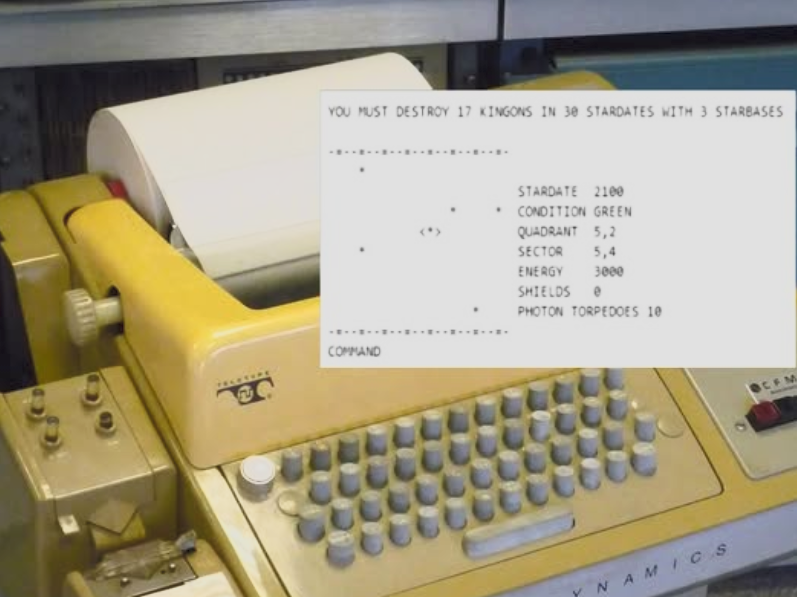
That picture of strtrk running on a print tty sure brings back memories. That’s how I played in High School, on a print tty connected via analog modem (you called the host computer, listened for the screech of the modem on the other side, then jammed the telephone handset into a couple of suction cups on the unit) calling a PDP-10 at SUNY Stony Brook.
I am sad to think of how many trees were cut down to feed my strtrk addiction. I’d keep the rolls of paper to review later… I was such a nerd. Oh wait, I’m still such a nerd!
Between you and Scopique, this is rapidly rising up my ‘gotta play it soon’ list!
That was exactly how I played it, too. I’d have LOTS and LOTS of paper to throw away after each game.
If I had to pay for that paper, I’d never have learned to program probably 🙂