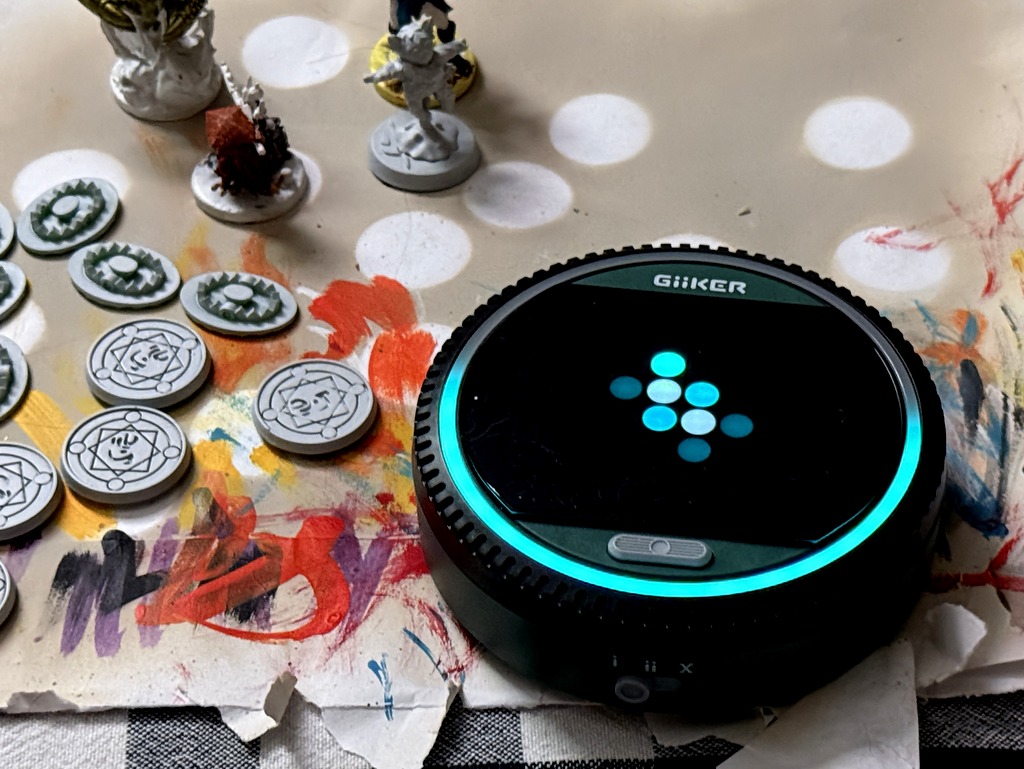
I was scrolling through the YouTubes and happened to come across a demo of the latest handheld game from GiiKER, “Super Reversi“. GiiKER makes a business from making premium handhelds for games like Mastermind and Sudoku, and they’re intended for children just learning these classic games.
I was really intrigued by the packaging. Super Reversi is a circular game with a square OLED screen against a black background. Circling the play area is a light bar that lights up white or green to indicate who is winning. The lightbar is surrounded by a movable ring that lets you select your moves. The screen itself shows the Othello/Reversi (Othello is the branded name for a popular Reversi variant; despite the name, this handheld plays Othello in that it skips the first two moves to start from a standard opening).
A large button on the face turns the game on and off, and is used to confirm a selected move. A sliding switch selects between one player, two player, and challenge mode. Challenge mode are a selection of 500 games in progress that are progressively harder to win.
In the header picture (which should be way greener than it appears here), you can see the “new game” arrangement. White and Green in a checkerboard pattern. In Super Reversi‘s solo mode, the player always plays Green and the computer always plays White. The potential moves are shown dimmed, aside from the currently selected move, which glows fully Green. Rotating the dial would select one of the others. Pressing the large button locks in the move.
The ads say straight out that the game will learn your moves and improve its game as you play. I’ve played almost a dozen games with it, and it hasn’t really improved, though I have noticed it taking longer to consider its moves, so perhaps it is getting better or perhaps I’m imagining it. There’s nothing in the manual about resetting the learning, so either they are wrong about it, or it only improves its play until you turn it off. In any event, I haven’t lost a game with it that I was paying attention to.
A couple of months ago, I wrote a console version of Othello with the intent to beat my personal Othello nemesis, Othello World for the Super Famicom. I wrote a genetic algorithm to tune the very best board state scoring algorithm without getting insane about “frontier” pieces and “quiet moves”. Then I paired it with the negamax algorithm. I could win on the lowest setting, but the deeper searches just punished me for any bad move. It did beat the final boss of Othello World (who was God, btw. Japanese games do not shy away from gamifying Christianity).
So after I’d played with the Super Reversi game a bit, I got to wondering how it would do against my game. I was fixing it to let me choose to play White (so the computer would make the Black moves), when I had an insane idea to use my game as the back end to a browser front end.
See, we’ve been doing exactly this at work. The place I work at is making the transition from Java to Python, and so I have been building up a lot of expertise with FastAPI and Pydantic. We have also begun moving to agentic development — vibe coding, corporate-style. So I decided to bring these work skills home and develop a front end with agents.
I know there’s people out there who will react with disgust to any mention of AI in any capacity whatsoever. And they value software made without the use of any AI tools. I get that. This is my job, and I like coding by hand. But my goal was to review this device without having to spend several nights writing the FastAPI layer and the browser front end.
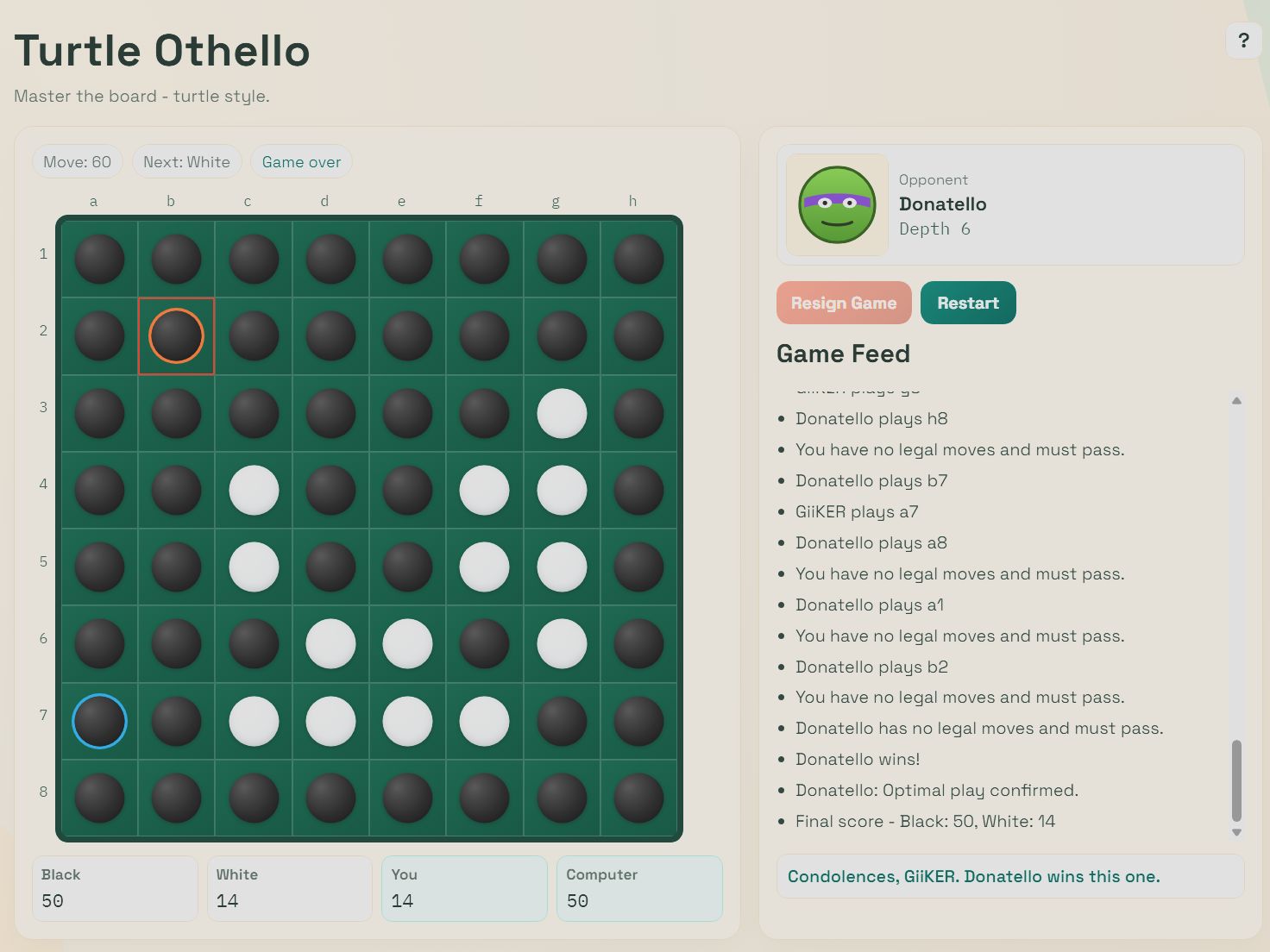
So I switched the VSCode Copilot to the “Plan” agent and described to the agent what I wanted to do. Turn my CLI game into a FastAPI back end, with complete unit testing verifying the game still worked in CLI mode and verified the REST API. Then I explained what I wanted from the front end, how I wanted the user to interact, and to use the Teenage Mutant Ninja Turtles as the difficulty levels, with Michelangelo as the “easiest” and Donatello as the “hardest”, with Raph and Leonardo providing the intermediate challenges. And I wanted the turtle portraits. And, and this is the important thing, I told it to set up a Playwright testing layer that would run the game in a headless Chrome instance and essentially use the UI to play the game at speed without letting me see it until it was not only working, but proven to work.
The first time I ran the game, it was playable. I then spent several hours playing it and suggesting improvements and finding bugs with edge cases (such as both players passing while there were still open spaces on the board).
Anyway, even Michelangelo had no trouble beating GiiKER, which is fair, because Mike and I are about 50/50. Donatello just laughs when I challenge him to a game, unless I bring pizza. Later: GiiKER did eventually beat Michelangelo. Maybe it is upping its game; maybe it resets when the batteries are pulled?
So the review part of this.
The GiiKER Super Reversi is a lot of fun. It looks slick, the controls are simple and innovative, and it’s going to teach you the game. Being brutally honest, sometimes I just like flipping discs and am not looking to spend ten minutes on a move. Othello is a game where two players try to trick the other player into making a Bad Move by removing all of their Good Moves. It’s stressful! GiiKER Super Reversi won’t punish you for the occasional wrong move.
This game isn’t made for Othello pros.
That said, I believe the game is upping its challenge, it’s just that I keep playing it against Turtle Othello in order to debug my game which just potentially improves both games.
So the AI part of this.
I am required to use agentic coding tools at work. They paid a lot of money for them, and so I have to use them. I am telling you now that every coder I talk to, in or out of the company I work for, is using AI codebots to some extent. Maybe they aren’t up to agentic coding, but it’s done. If you will only play a game that has been coded with no AI help whatsoever, you are going to be playing very few modern games because I promise you, all the game studios are using AI to some extent. Maybe not AI art, but code? Yeah.
Working, testable and tested code, full coverage, able to follow your bright ideas wherever they lead? It’s a game changer. A literal game changer. I get to spend more time playing the game and iterating toward the fun than dodging syntax errors and 12AM spaghetti code. So, yeah. Like it or not, it’s isn’t happening, it has already happened.


If I live that long, I’m going to be amused in 10 years when we have to tell 20-something folks “We used to have to APOLOGIZE for using AI tools.” and they’ll be like “No way, you so cray-cray grampa!”
One of the big pushes in our annual goals is to incorporate AI into our jobs more. Which is fine except… IT says not to use unsanctioned tools and they haven’t provided us with any sanctioned tools. So that’ll be fun. Maybe I’ll put together a local model that can run in the 12 GB VRAM video card I have in my work machine. 🙂
I got added to an “AI Slop” block list on BlueSky, so I am a little on the edge about disclosing my AI use there. I don’t like that billionaires want to use it as a tool of theft, surveillance and control, but I can’t deny it can be useful.
As far as coding goes, using AI is using software to write software, isn’t it? Apart from anyone specifically at risk of being put out of work by that, how does anyone manage to get worked up over it? Why would any gamer care if some software had helped with some of the software in the game they were about to play? Beats me, but then I have zero emotional connection to coding in any form. Intellectually I understand other people do have that connection but it’s like those stories where someone marries a building – impossible to comprehend let alone empathize with.
AI art/music/writing is a different issue, though. I find it much easier to see what freaks people out about that or makes them angry. Doesn’t have that effect on me but at least I can see where they’re having a problem with it. My own problem with a lot of it is still that it’s just not very good. If and when it gets better then I’ll be fine with it but I’ve been following the progress for a few years now and I can’t see a lot of evidence of improvement beyond a certain baseline. I suspect the term AI Slop wouldn’t have gained the currency it has if so much of it wasn’t so sloppy.
Well, there’s two ways I think creatives think about AI with their work.
One is, the AI will write a story as good as one I write, or paint as well as I paint in exactly my style, etc. I was watching some videos about people who make X-rated animal people, and there was big controversy that one of the sexy catgirl artists was tracing AI. Well, it was probably easy because there is nothing at all original about that art. I think real artists can harness creativity that AI can never match. If your art is just doing the same thing everyone else is doing, well, AI can do non-creative stuff as well as anyone.
The other is from professional copywriters, illustrators etc whose jobs are skilled but not particularly creative. These are the people rightfully worried AI will take their jobs; while they could probably produce better output, they can’t beat fifteen variations on a theme in 30 seconds.
I guess a third are from the writers and artists whose works were used to train the LLMs. Those people should take the billionaires that stole their work for every penny they have.
Personally, as a side-hobby artist and writer that is more skilled in marketing and PR:
AI has never felt like a threat to real, genuine artists… or any other employment, on that matter. I agree that a human can never be replaced with AI in terms of creativity. But an AI can never replace a human in terms of “personability” either.
Take for instance animators. Their work, far more than artists, is in danger from AI, as an AI simply has to learn patterns that animators use for in-betweens and crank them out 100x faster than any group of animators can manage. Forget the artists and storyboard artists: their jobs are safe so long as they have the talent. But the animators? They’d be the first to go…. Except…
Animators can discuss, negotiate, and personalize far better than any AI ever can, no matter how much AI progresses in technology. That unique touch they can provide to a work is unmatched. It’s a form of creativity that relies on their personability with those around them. Their “collaborativity”. An AI can try to match what you’re looking for. A human can think “no, I can do it better than your plan, and add a nice, personal easter egg too that acts as an unique love letter to the fans.”
Then, take for instance, auditors. Nothing can audit faster and more accurately than a well-trained, in-house machine. However, as my wife works in the city government, she knows well enough that there’s a lot of personal flexibility required when it comes to dealing with businesses and individuals. For instance, some companies in the city are allowed to pay in larger sums of tax, loans, and etc over longer periods of times compared to other companies, even though the rules dictate that all must pay a certain amount over the same amount of time. But that is because these companies are run by individuals who have not only shown reliability in their promises, but have to deal with uncontrollable issues that pop up at the most unexpected of times. This requires intimate and personal knowledge between the contractors and contractees, with the innate ability to judge character and flex contacts creatively.
Lastly, take for instance, customer service and scheduler jobs. These can easily be replaced with an in-house AI that perfectly memorizes and manages queries, calendars, and company procedures… except nearly half of all customer service calls must deal with product/service issues that not even the company could predict. And more than half of rescheduling and replanning fiascos have to deal with complications outside of contractual agreements. Without the human element, these issues would be discarded in an instant in order to avoid confusing the AI’s learning patterns.
No job roles are in *true* danger of being replaced by AI.
Jobs themselves? Yes, depending on the upper management’s decisions, thousands of jobs are in danger for the sake of optimization. But optimization can’t fully replace personability. Humans aren’t blocks and numbers.
To me, AI is no different than the invention of automobiles or the industrial revolution:
The only jobs/inventions that vanished were the ones that tried to compete with the next step in technology.
The ones that survived were ones who either knew how to integrate their job/invention with the new tech, or knew how to market their job/invention in another category.
We still have horse breeders despite having cars.
We still have clock makers and watchmakers, wood carvers and carpenters, blacksmiths and threadworkers, despite mass production existing.
We still have restaurants despite fast food taking over.
We still have caterers and taxis despite Doordash and Uber becoming the norm.
It’s about how you sell your work to the public within the new age, not how it can beat the competition.
Honestly, artists have the most to gain by working with AI.
But they’re so stubbornly against it that they can’t see the potential growth of their own markets.